Costs
Roof replacement cost in 2026
Yakka Labour's October 2026 guide puts many full re-roofing examples around $18,000 to $45,000, with wider results for particular materials and conditions. Other published guides use very different scopes. Compare the complete work before using a square-metre rate to judge your quote.
By roof type
| Old roof to new roof | Per m² | Example with 200 m² of roof |
|---|---|---|
| Old metal to Colorbond | $85 to $140 | $17,000 to $28,000 |
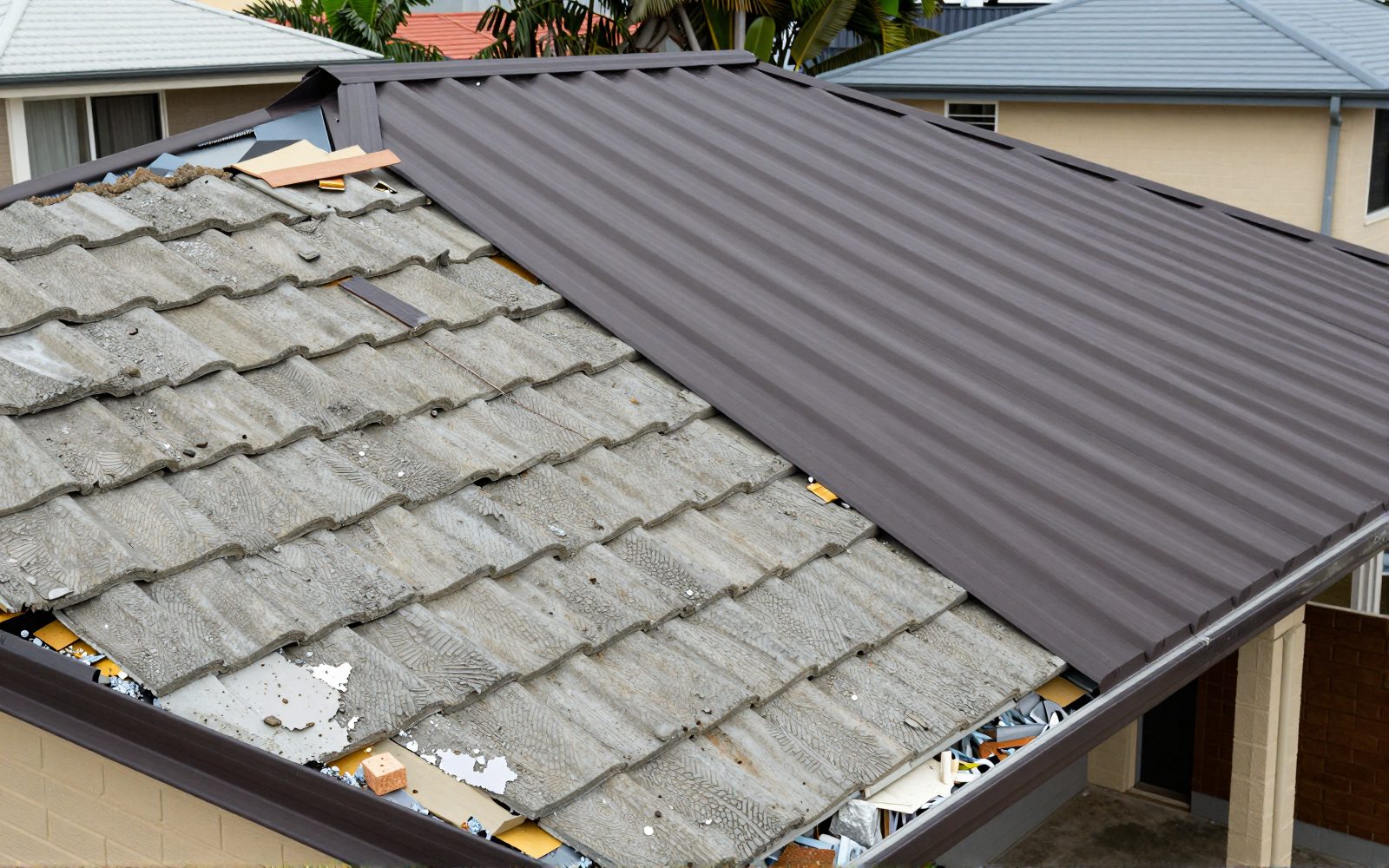
| Concrete or terracotta tiles to Colorbond | $100 to $170 | $20,000 to $34,000 |
| Concrete tiles to new concrete tiles | $110 to $180 | $22,000 to $36,000 |
| Tiles to new terracotta tiles | $150 to $250 | $30,000 to $50,000 |
| Asbestos cement sheet to Colorbond | $140 to $250 | $28,000 to $50,000 |
By city (tile to Colorbond, per m²)
| City | Tile to Colorbond | Metal to metal |
|---|---|---|
| Sydney | $115 to $175 | $95 to $150 |
| Melbourne | $105 to $165 | $90 to $140 |
| Brisbane | $100 to $160 | $85 to $135 |
| Perth | $100 to $160 | $85 to $135 |
| Adelaide | $95 to $150 | $80 to $125 |
| Hobart | $100 to $160 | $85 to $135 |
| Canberra | $110 to $170 | $90 to $145 |
| Darwin | $130 to $200 | $110 to $170 |
Yakka Labour roof replacement guide, October 2026. Ranges, not quotes.
What is often extra
Scaffold on a two-storey house ($3,000 to $8,000), new gutters and downpipes ($3,000 to $6,000), rotten battens and fascia, and moving solar panels, according to Yakka Labour.
Restore instead?
If the existing covering is suitable to retain, compare an itemised restoration with replacement. The lower headline price is not enough to decide: the inspection must establish which work addresses the roof's condition and your objective.
Published prices are not one consistent benchmark
| Published guide | Example it gives | How to use it |
|---|---|---|
| Yakka Labour, October 2026 | Old metal to Colorbond: $85 to $140 per m² | A stated re-roofing category; check its inclusions against the actual quote |
| hipages, January 2026 | Colorbond: $18 to $37 per m²; separate three-bedroom examples start at $6,000 to $10,000 | Different published examples; the text notes possible exclusions for structural work and removal |
Those figures are far apart. We cannot turn them into a reliable market average by adding the endpoints or choosing the cheapest. The publishers describe different examples and exclusions, and neither is a measured quote for your roof. The useful next step is a property-specific scope with the same inclusions for every contractor.
In particular, do not treat an internet rate as proof that a complete replacement must cost a particular amount. Ask whether the comparison includes removing the old covering, disposal, access, supporting work and the connected roof components. A broad product label does not resolve those questions.
Measure roof surface, not house floor area
The square metres in a roofing rate need to describe the affected roof surface. A home's floor area does not automatically equal that surface. Pitched slopes, overhangs, additions, garages and other sections need to be identified in the contractor's measurement and scope.
The table's 200 m² examples are therefore examples of 200 m² of roof, not a promise for every house advertised as 200 m². Ask which roof planes and attached structures are included. A partial re-roof and a complete covering replacement should not use the same description without that distinction.
Our roof pitch calculator explains why a sloping surface differs from its horizontal projection. Its simplified geometric examples are not a roof-material order: actual quantities also need the product layout, junctions and required allowances established by the professional.
A worked area-and-rate comparison
For an assumed 200 m² roof, multiplying an illustrative rate of $120 per m² gives $24,000. At $150 per m², the same area gives $30,000. Those rates are chosen for a mathematical example; they are not offers or prices we obtained from roofers.
Now change the assumed area to 240 m² while retaining $120 per m². The result is $28,800. That is $4,800 more than the 200 m² example without changing the rate at all. An incorrect area can therefore distort the comparison before any question about pricing or materials is considered.
The rate calculation still does not establish the total scope. If an actual contractor quotes a complete job, identify what its total includes rather than adding internet allowances to it automatically. If a component is already included, adding a second allowance for the same item counts it twice.
Changing roof covering is a specification decision
Replacing metal with a specified new metal system is a different proposal from changing a tiled roof to sheets or selecting new tiles. Have the professional identify the existing structure, proposed covering and any related design or support work. This guide does not assess the suitability of a material change for your building.
A quote should identify the actual product and profile, not just a colour or general material name. For metal sheets, the manufacturer's installation requirements belong with that selection. For tiles, use the named tile system and relevant guidance. Product availability does not, by itself, establish that the existing roof arrangement suits it.
Ask which supporting components remain and what inspection or further assessment is needed before work starts. A cheaper-looking covering is not automatically the cheaper completed project if the related work differs. Compare complete options supported by the actual findings.
Flashings and junctions belong in the replacement scope
Identify work around walls, chimneys, skylights, pipes and other roof penetrations. A price for the broad roof surface does not explain whether every adjoining flashing and junction is renewed, retained or altered. The specification should make those choices visible.
Ask the contractor how new components connect to retained parts and how their condition and compatibility are assessed. Our roof flashing guide explains the terms used for those details. Keep the marked locations or drawings with the written quote so they can be checked against the completed work.
If a particular junction is the reason for replacing the roof, make sure the proposed work explains how it is addressed. A new covering should not become a substitute for identifying the cause of an existing leak. For current water entry, see roof leaking before considering the permanent scope.
Insulation, membranes and ventilation are separate items
Ask the quote to state what happens to existing sarking, roof blankets and insulation, and what new products are specified. These are different components with different purposes. A description such as "insulation included" leaves the actual product, position and scope unclear.
The sarking guide distinguishes membranes from insulation blankets and describes the named NCC 2022 condensation provisions without claiming that one product resolves every roof assembly. The designer needs to identify the requirements applicable to the actual work and location.
If one offer retains a component while another replaces it, resolve the difference before comparing totals. Ask which inspection findings support retention, which work is excluded and how further issues discovered after the covering is removed would be discussed and priced.
Gutters and downpipes may be a separate project
A roof replacement does not automatically mean that all gutters, outlets and downpipes are replaced. Ask which existing components remain, what condition was found and whether any drainage changes are part of the proposal. Identify work on attached structures and internal gutters separately.
If new roof areas or altered discharge points affect drainage, ask how the complete water route is assessed. A larger-looking gutter or an extra downpipe chosen without the roof-specific design does not establish suitability. The overflowing gutters guide explains the distinction between a spacing example and a drainage assessment.
Use gutter replacement cost to discuss budgeting for a separate identified scope. Do not add its entire whole-house range to a roof quote that already includes the same gutter work. The written inclusions should make clear what is counted once and what remains outside the project.
Access, removal and disposal affect the completed price
Tell the contractor about building height, narrow boundaries, attached structures and any known access restrictions. The provider needs to plan a safe method appropriate to the actual work. This page does not provide instructions for roof access, lifting or removal.
Confirm whether taking away the old covering, associated waste and any temporary arrangements are included. If the existing material is uncertain or suspected to contain asbestos, have that uncertainty resolved by an appropriately qualified professional before ordinary cleaning or removal is priced as though the material were known.
SafeWork NSW identifies asbestos risks when renovating older roofs and connected components. Do not sample, cut or pressure-clean suspect material yourself. Ask the relevant provider to identify the assessment, removal and disposal arrangements required for the material and jurisdiction.
Solar equipment and other roof-mounted items
Identify solar equipment, antennas, skylights, vents and any other installation that may affect the work. Ask what the roofing contractor includes, what remains in place and which separate providers are responsible for any disconnection, relocation or reinstatement.
Do not assume a roofing quote includes electrical work or changes to every connected installation. Record who coordinates the tasks and which items are excluded. If equipment is retained, ask how it is considered in the proposed roof layout and completed scope.
Keep that information with the product specification and quote. A comparison between two complete proposals needs to include the same identified equipment arrangements; otherwise the lower headline total may simply leave more work to be organised separately.
Compare the inspection finding with the proposed extent
If a full replacement is recommended, ask how the inspection supports that extent of work. Identify what can be retained, what must be renewed and which uncertainties need further assessment. The age or appearance of a roof alone is not a complete condition report.
A repair, a restoration and a replacement are different options only when their actual scopes are defined. One proposal might address a local leak; another may include widespread covering renewal and related components. A simple cost ratio cannot decide which solves the identified problem or suits the intended project.
Where several issues are found, ask the contractor to separate them in the report. That makes it possible to understand the reason for each component of the quote rather than treating the entire total as the price of a single visible defect.
City tables are context, not a local quote
The city figures above reproduce the cited publisher's indicative categories. They are not contractor quotes collected by this publication, and they should not be treated as a ranking of which city always costs more. A material, access or scope difference within one suburb can matter more to a particular project than a broad city label.
Use the category that most closely describes the proposed change as a starting point for discussion. Then replace that general comparison with actual measured area, specified products, access, supporting work and exclusions. Do not transfer a single-storey example to a different property without resolving those differences.
When discussing a quote that sits outside a published range, ask which elements explain the scope and price. The difference may require clarification, but the internet range alone does not establish that the quote is correct or incorrect.
What to obtain before accepting the job
Keep the inspection findings, affected roof area, selected covering, supporting work, flashings, membranes, drainage, equipment, access, removal, total including GST and exclusions in one written scope. Ask how proposed additional work would be documented and agreed if hidden conditions are discovered.
Check the contractor's entitlement for the actual work in the relevant state; see what roof plumbing is. Ask which approvals and completion documents apply to the proposed project rather than assuming one national rule or a particular certificate for every job.
If several providers are involved, identify who is responsible for each task and how their scopes meet. Keep those arrangements with the quote so a question about a roof-mounted item or connected drain does not fall between two different proposals.
Keep a useful handover record
Agree the work sequence and temporary arrangements
Before work begins, ask how the contractor plans the sequence, access and temporary protection while the covering is being replaced. Identify any areas or equipment that will be unavailable and how changes to the planned dates will be communicated. A price guide cannot give a reliable completion time for an unspecified roof and scope.
If the house remains occupied, make the agreed arrangements clear to everyone using it. Keep people away from the contractor's work areas and do not access the roof to inspect progress. Ask the provider to explain how photographs, updates or inspections will be supplied safely instead.
Where separate trades or mounted equipment are involved, establish who coordinates their attendance. The agreed plan should say what happens between the roofing work and any related reinstatement, so the completed price comparison includes the actual sequence being purchased.
At completion, retain the product details, agreed changes, supplied photographs, applicable documents and maintenance instructions. Record which components were replaced and which remained. A description such as "new roof" is not enough to explain the finished assembly to a later contractor.
Ask who provides any offered product warranty and installation warranty, what each covers and which conditions or exclusions apply. A warranty's headline duration does not establish that all future repairs or maintenance are free. Use its actual terms and the manufacturer's instructions when planning care.
If a leak, defect or other concern later appears, document it and refer to that completed scope. Have the issue assessed rather than assuming either that the entire replacement failed or that a new roof means no further investigation can be needed.
Common questions
How much does a new roof cost in Australia?
About $18,000 to $45,000 for a typical house in 2026, or $85 to $250 per square metre, according to Yakka Labour.
How much does tile to Colorbond cost?
About $100 to $170 per square metre, or $20,000 to $34,000 for a 200 m² roof.
Sources
- Yakka Labour, Roof replacement cost guide (October 2026)
- hipages, How much does roof replacement cost? (6 January 2026)
- Monier, Roof replacement and re-roofing
- SafeWork NSW, Managing risks of exposure to asbestos
- Lysaght, Roofing and walling installation manual
Checked 15 October 2026. Prices are published ranges, not quotes; rules differ by state.